Pipeline Generation on HubSpot for Enterprise SaaS
Pipeline generation breaks down first when growth accelerates. More channels, more stakeholders, more tools and suddenly nobody can clearly answer three basic questions. Where is our pipeline coming from. Which deals are real. What will actually close. HubSpot can absolutely solve this but only if pipeline generation is treated as a system, not as a collection of campaigns and dashboards.
This guide walks through how Enterprise SaaS teams can build a predictable pipeline engine in HubSpot by aligning strategy, data, processes and execution. No theory. Only patterns that scale.
Most pipeline problems are not caused by a lack of leads. They are caused by structural issues inside the CRM and the go to market motion.
Typical symptoms look familiar.
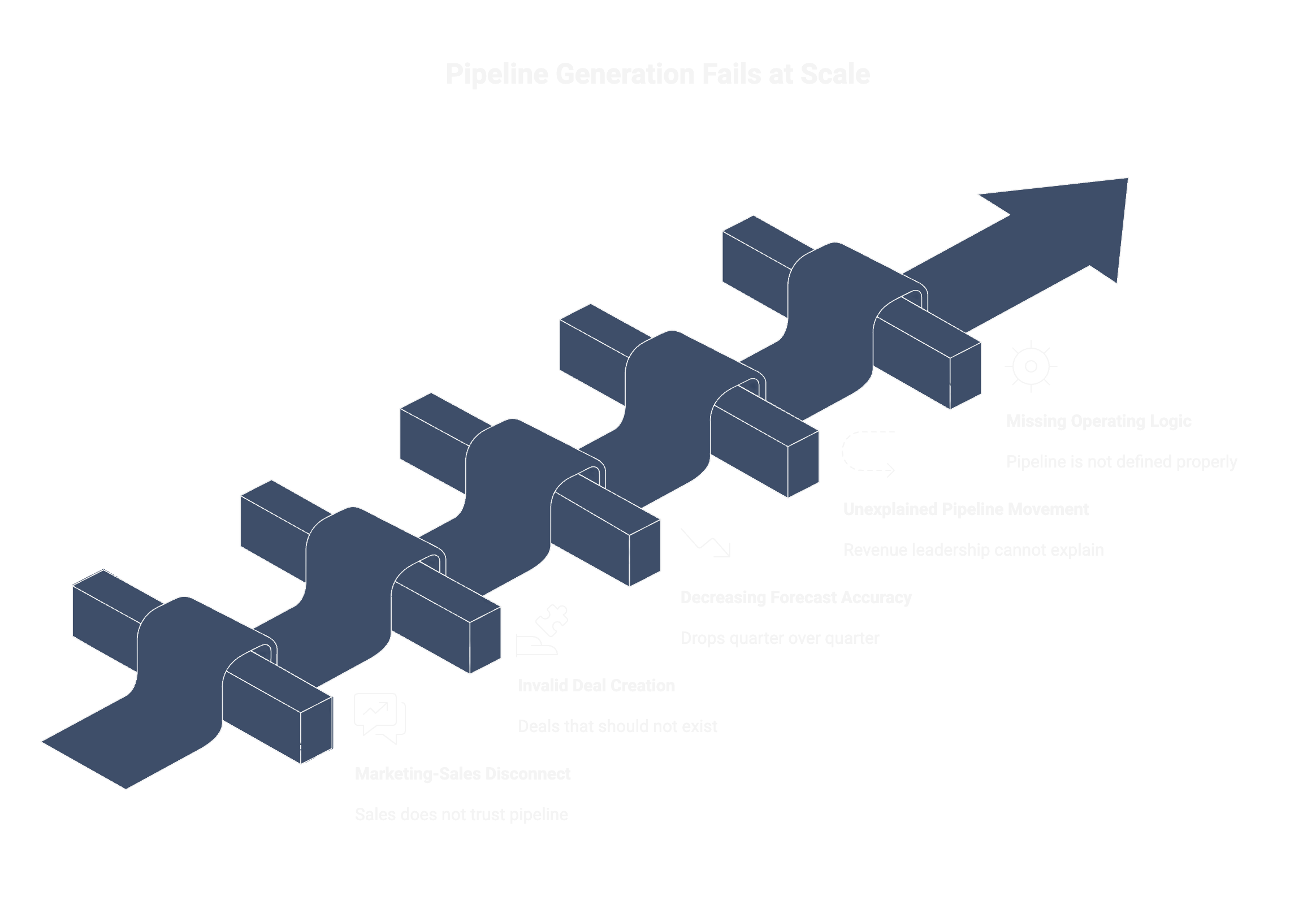
• Marketing reports pipeline that Sales does not trust • Sales works deals that never should have been created • Forecast accuracy drops quarter over quarter • Revenue leadership cannot explain pipeline movement
At this point HubSpot is often blamed, but the real issue is missing operating logic. Before you generate more pipeline, you need to fix how pipeline is defined, created and governed.
Start With One Clear Definition of Pipeline
Predictable pipeline starts with a shared definition. Not per team. Not per dashboard. One definition that Marketing, Sales and RevOps agree on.
Pipeline in HubSpot should only include deals that meet all of the following criteria.
• A real business problem is identified • A buying role is known • A next step exists • Ownership is clear
Everything else is activity, not pipeline.
If you want to go deeper into how to align Marketing and Sales around deal quality, the article on No Bullshit Sales Reporting in 2025 explains how to design pipelines and reports that teams actually trust
Design the Right Pipeline Structure in HubSpot
Enterprise SaaS teams often overcomplicate HubSpot pipelines with good intentions. Regional pipelines, product specific pipelines, campaign pipelines. Each addition feels helpful in isolation, but together they fragment data, break reporting, and make forecasting unreliable. The result is a CRM that looks busy but explains very little.
A scalable pipeline structure in HubSpot starts by reducing complexity, not adding more layers. The core principle is simple. Pipelines should represent sales motions, not organizational structure.
For most Enterprise SaaS businesses, this means a very small number of pipelines.
• New Business • Expansion or Existing Business
Everything else belongs in properties, views, and reports, not in separate pipelines.
Within each pipeline, stages must be defined from the buyer’s perspective. A stage is not “Discovery Call Completed” or “Proposal Sent” because those are internal actions. A stage should reflect a clear change in buyer commitment or understanding, such as problem confirmed, solution aligned, or commercial agreement in progress.
To protect pipeline quality, each stage needs explicit entry criteria. Moving a deal forward should require specific information to be present, such as a confirmed pain, identified stakeholders, or a defined next step. This is where HubSpot works best when paired with governance. Mandatory fields and workflow based checks ensure that deals cannot advance unless they meet the agreed standard.
Stages are not checklists that Sales can click through. They are gates. When a deal moves forward without meeting the criteria, the pipeline stops being a planning tool and becomes a fiction. Strong pipeline structure creates trust in the data, which is the foundation for accurate forecasting and meaningful revenue discussions.
Pipeline Generation Is Not Lead Generation
One of the hardest shifts for Enterprise SaaS teams is letting go of lead volume as a success metric. High lead numbers look good in dashboards, but they rarely correlate with revenue once deal sizes grow and buying committees expand.
Pipeline generation is not about creating more contacts in HubSpot. It is about creating sales ready opportunities that have a realistic chance of converting into revenue. Everything else is noise.
This is where many teams get stuck. Marketing is measured on leads. Sales is measured on revenue. Without a shared qualification framework, both sides optimize for different outcomes and pipeline quality suffers.
Lead scoring and account scoring create that shared language.
A strong scoring model answers three fundamental questions every time a signal enters the system.
• Is this account actually a fit for our business • Is there real intent right now or just casual interest • Is Sales supposed to act immediately or later
HubSpot allows you to separate these signals instead of collapsing them into one vague score. Fit scores evaluate whether the account matches your ideal customer profile. Engagement scores capture intent across marketing and sales interactions. Product scores, where relevant, surface usage based signals that often indicate buying momentum.
Running multiple scores in parallel is what makes pipeline generation scalable. Marketing can focus on warming the right accounts. Sales can prioritize outreach based on real buying signals. Product and Customer teams can surface expansion opportunities without polluting the new business pipeline.
When pipeline generation is driven by scoring instead of volume, HubSpot stops being a contact database and starts functioning as a revenue engine.
Build Repeatable Pipeline Sources
Predictable pipeline does not come from random wins. It comes from repeatable sources that are measured and optimized over time.
In Enterprise SaaS, the strongest pipeline sources usually include.
• High intent inbound such as demo and pricing interactions • Targeted ABM motions on named accounts • Product driven signals from trials or freemium usage • Expansion and cross sell from existing customers
Each source should have a clear entry point into the pipeline, clear ownership and clear SLAs.
Account Based motions deserve special attention here. ABM is not a campaign. It is an operating model. If you want to structure ABM inside HubSpot without over engineering, the Pilot First ABM Playbook is a practical blueprint.
Use Workflows to Protect Pipeline Quality
Once pipeline sources are defined, workflows turn intent into action.
Well designed workflows in HubSpot handle things like.
• Creating deals only when qualification thresholds are met • Assigning ownership and tasks automatically • Suppressing marketing outreach once Sales is engaged • Recycling stalled deals without manual cleanup
The goal is simple. Sales should spend time selling, not fixing CRM data.
Workflows should start simple and evolve over time. If you automate chaos, you only get faster chaos. Always validate manually before scaling automation.
Measure Pipeline Like a Revenue Operator
Dashboards alone do not create predictability. Operating rhythm does.
Enterprise teams that succeed with HubSpot review pipeline weekly with the same core questions.
• How much pipeline did we create • How much pipeline progressed • Where are deals getting stuck • What changed since last week
Key metrics to track consistently include.
• Pipeline coverage versus target • Conversion between stages • Time spent in each stage • Win rate by source
When these metrics are stable, forecasting becomes a byproduct, not a fight.
From Chaos to Control
Pipeline generation on HubSpot works when the system is designed for how buyers actually buy, not how teams wish they bought.
When HubSpot becomes the single source of truth for pipeline creation and progression, revenue stops being a guessing game and starts becoming predictable.
If you already have HubSpot in place, you do not need more tools. You need sharper structure.
Frequently Asked Questions
How long does it take to see results?
You’ll see better visibility within weeks, but meaningful pipeline impact typically appears within 3–6 months as data quality and automation mature.
Is this only for large enterprise teams?
No. Smaller teams benefit even more because automation replaces headcount, and clarity replaces guesswork.
Do we need all HubSpot Hubs to start?
No. Sales Hub + Marketing Hub provide a strong foundation. Additional hubs increase leverage over time.
What’s the biggest mistake teams make?
Over-engineering before fundamentals are in place. Clean data, clear stages, and simple automation always come first.
Can this work with outbound and ABM?
Yes – HubSpot is especially strong when inbound and outbound signals are unified at the account level.
Other Articles
5
min Read Time
-
Manuel Hartmann
LinkedIn als integrierte Go-to-Market Engine
Nur etwa 5 % deines Marktes kaufen gerade aktiv. Die anderen 95 % haben das Problem zwar ebenfalls, aber noch keinen konkreten Anlass, sich damit zu beschäftigen. Ob du in 6, 12 oder 18 Monaten auf der Shortlist stehst, entscheidet sich vorher. Genau dort endet klassisches Performance-Marketing, und genau dort beginnt Demand Generation auf LinkedIn.
Wieso bei <1’000 Mitarbeitern HubSpot Marketing Hub sinnvoller ist als Marketo
Für CEOs, CROs & Marketing Leader, die Tools operieren, nicht bewundern wollen.
Die meisten Marketo-Setups in mittelgroßen B2B-Unternehmen haben ein gemeinsames Problem: Sie können mehr, als das Team jemals nutzt. Über Jahre gewachsen, vollgepackt mit Smart Campaigns, die niemand mehr anfasst, Scoring-Regeln, denen der Vertrieb nicht traut, und Reporting, das keiner als Entscheidungsgrundlage ernst nimmt. Bezahlt wird für die Vollausstattung. Genutzt wird ein Bruchteil.
Genau hier liegt die eigentliche Frage – und sie hat nichts mit Feature-Listen zu tun. Sie lautet: Welches System kann mein Team in seiner realen Größe tatsächlich bedienen, ohne dafür eine eigene Marketing-Ops-Abteilung zu unterhalten?
Signals Don't Tell You Who Wants to Buy. Here's What They Actually Tell You
Open any sales newsletter today and you'll find the same promise: monitor "buying signals" and "intent data", then pipeline will follow. The vendors selling these tools have trained an entire generation of GTM teams to believe that a website visit, a LinkedIn profile view, or a competitor keyword search means someone is ready to buy.



.png)

.png)